When we launched MOSHI in 2015, the lack of attention and memory impairment in digital native population was one problem we wanted to tackle. Therefore, improving brain memory plasticity was very important. During our workshops at Paris Plages, participants were asked to summarize or formulate in their own way what was said before. It helped to develop active listening and empathy. This technique became a standard for facilitating Moshi debates.
Another key dimension of the MOSHI Method was built during the summer of 2015: starting the debate from facts to generate theories. Children always begin their discussions by sharing facts from their daily lives. By asking Socratic questions, Moshi educators help them analyze these lived experiences and, in turn, formulate theories. We called this educational method the stair methodology, based on inductive thinking. Then, from constructed theories, participants used artmaking as a means to return to practical ideas based on deductive thinking.
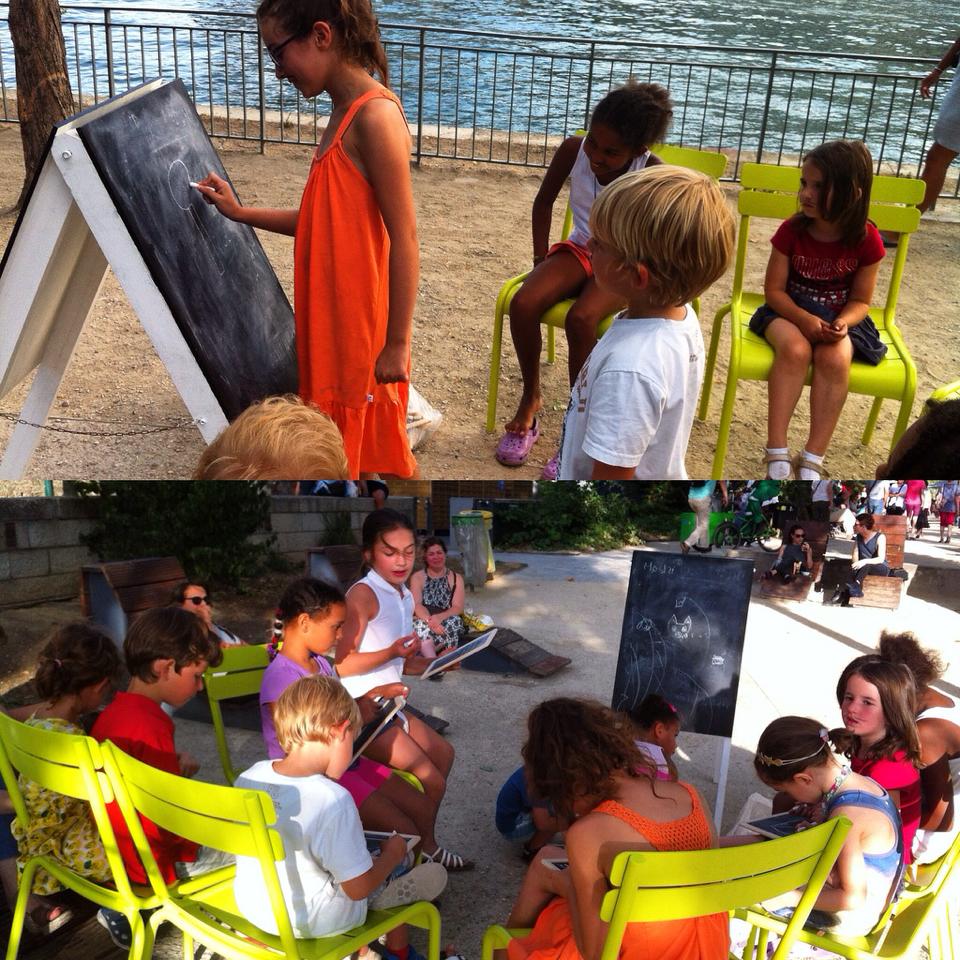
The third part of the workshop was the production of artworks as answers to the philosophical question. One activity was the use of mixed-media: traditional tools (papers, pencils, markers, playdoh) with digital device (stop-motion app on tablets) to express ideas discussed before in creative ways.
In terms of social learning, we promoted peer-to-peer method. Children helped each other to overcome what they did not know.
To achieve the production of an artistic piece such as stop-motion required patience, focus and inventivity. Most of the participants had never made one. Learning this new creative technique in one hour was also a practical challenge. One question posed was how could the exchange of philosophical ideas about surpassing oneself help to increase “productivity” learning?
In agreement with Ludwig Wittgenstein’s and Jacques Lacan’s philosophy, we believe that words can be very powerful. To verbalize difficulties encountered in everyday life and then problematize those issues through the philosophical lens allowed children to have a bigger picture and alleviate their anxiety.
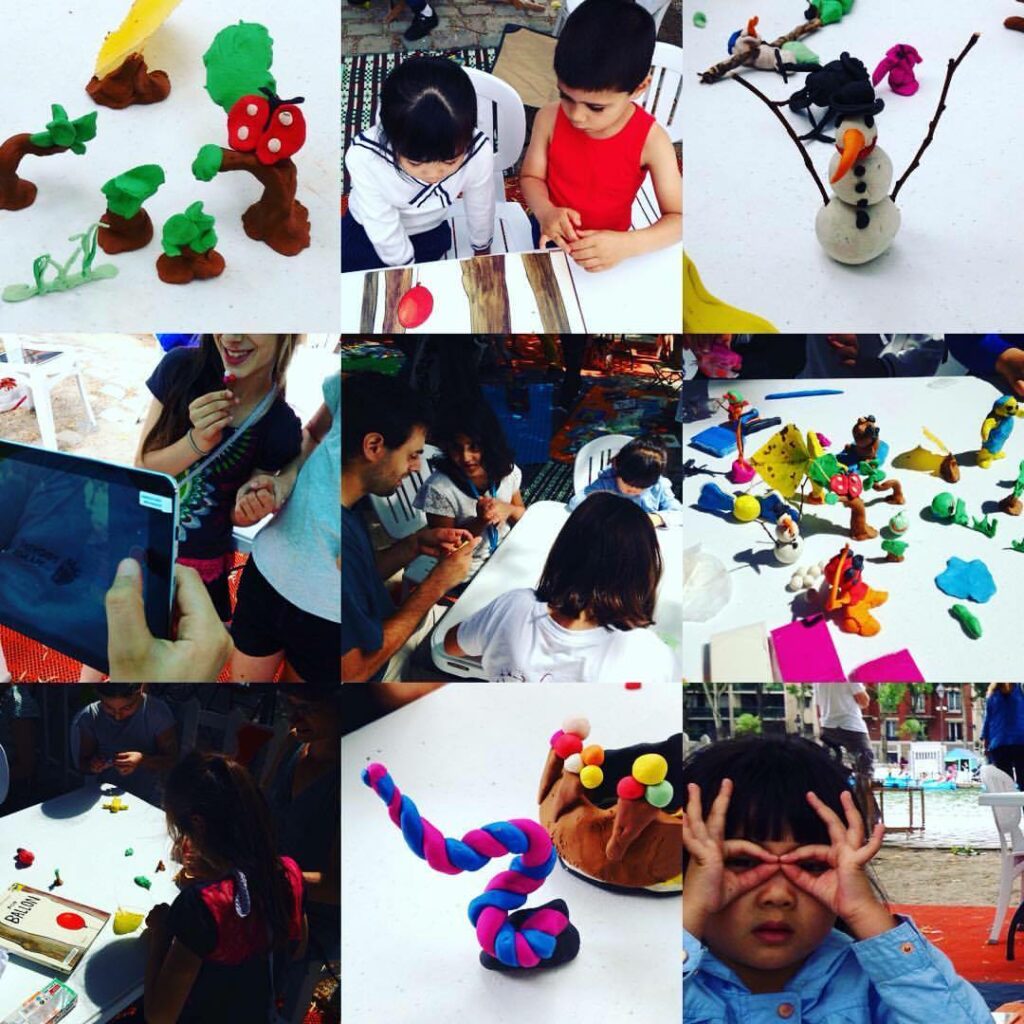
From this larger frame, children could think outside the box in order to make their own piece of art. Like a toolbox, the philosophical debate helped them to shape their ideas into stories, characters, colors, and shapes moving all together to form a philo-artistic narrative. In groups of 3 to 5, they made paper animals, persons, and objects and wrote short screenplays, embedding their heroic ideas into cute, funny and witty characters that took on superpowers.
Their imagination bloomed from their intellectual reasoning to answer philosophical questions. Indeed, thinking critically is a tool to develop children’s creativity.
In terms of emotional learning, we noticed that mimetism was the glue to build self-confidence through achievement. Daring to jump, to speak out loud, to articulate ideas with others even if they did not agree, and to make a creative piece with new tools were steps to self-satisfaction. Every participant was leaving the workshop with a big smile below their moustache. And they came back to participate in another workshop whenever they could.
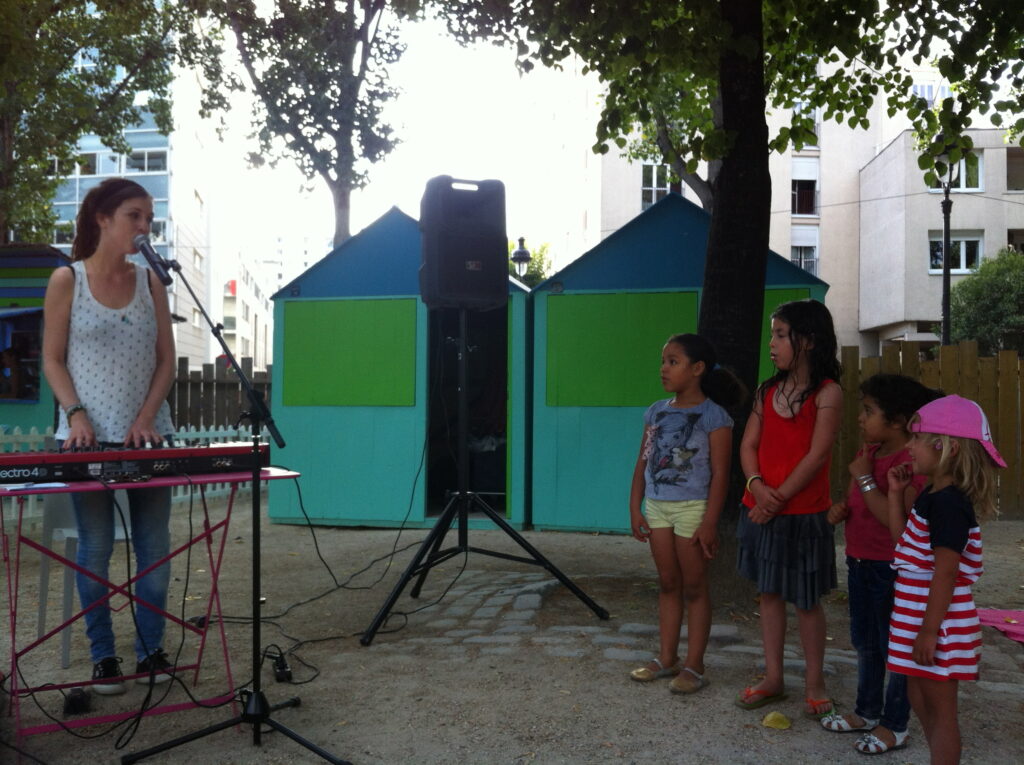
Every day, during Moshi program at Paris Plages 2015, we invited musicians and professional dancers to perform and transmit their talent to children. The workshops were open to children from 5 to 12 years. Parents were allowed to help if they wanted. The average was 10 participants per workshop; equal mix of boys and girls. The participants were children from working class and middle class families with various ethnic and religious background: Agnostics, North African and Sub-Saharan Muslims, North African and Middle-eastern Jews, European Catholics and Christians, South Asian Hindus. As the Paris Plages event is intended for Parisians who cannot afford summer vacation, the workshops were free of charge for the families.
The essay was originally published in the collective book “Growing Up With Philosophy Camps. How Learning to Think Develops Friendship, Community, and a Sense of Self” (ed. Claire Katz), Rowman & Littlefield, 2020.