When an idea blooms in the mind, it is a whole world that opens. The philo-artistic concept MOSHI was born from an audiovisual project for children that consisted of a series of short animations traveling with Fredo and Moshi 🥸 {aka Friedrich Nietzsche} and his moustache into world history through the lens of philosophical concepts. However, tragic social circumstances turned this project into interactive workshops where the heroes were no longer cartoon characters, but the children themselves.
The philo-artistic program started in Paris, France in summer 2015 as an answer to the Charlie Hebdo attacks. The mayor of Paris commissioned the first philo-artistic workshops to be launched during the annual summer festival event, Paris Plages (Paris Beach). It was necessary to alleviate children’s anxiety with play, arts and philosophy with Friedrich Nietzsche’s moustache used as make-up.
For a month, two hours a day, seven days a week, children were invited to express their personal ideas based on a philosophical question that changed every day. The first question was: what is surpassing yourself? It referred to Gaston Bachelard’s quote written on a blackboard at the entrance of the workshop spot: “a man is a man to the extent that he is a superman. A man should be defined by the sum of those tendencies which impel him to surpass the human condition.”
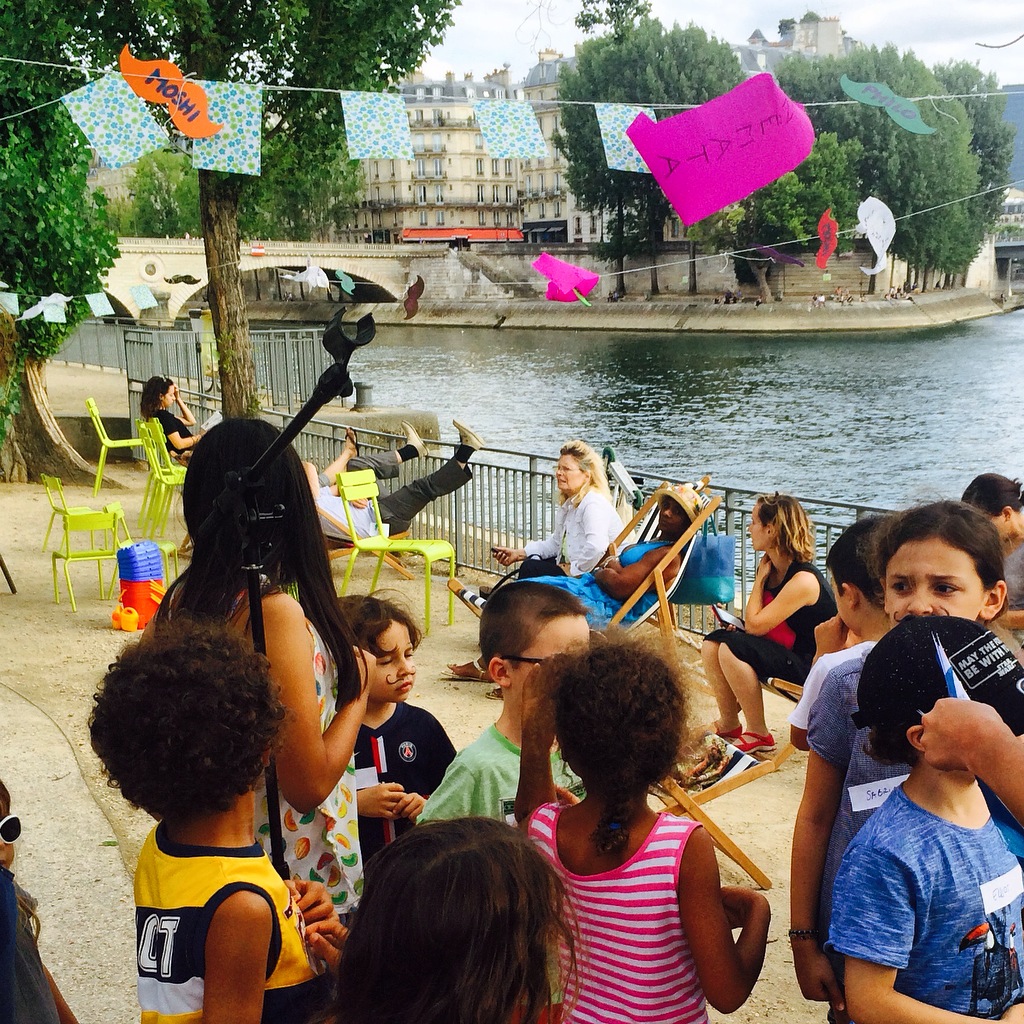
The workshop started with games: leapfrog, double-dutch, tug-of-war. As participants didn’t know each other, those games were a means to introduce them to each other in a fun way and gain confidence to speak out their ideas during the second part of the workshop. These games illustrated Friedrich Nietzsche’s philosophical concept that truth is embedded into the body, and helped children to verbally release it during the philosophical debate. The second part of the workshop was the philosophical group discussion based on the question of the day and the Socratic method led by the Moshi educator, with the use of a phenomenological magic tool: the microphone 🎤
The use of the microphone was contingent to the environment — noisy outdoor setting along the Seine River — in order for the participants to listen to each other and the bystanders to hear what children had to say. The microphone revealed itself to be much more than an amplification device. It became a social-emotional tool 🎤 for introverted and timid children to speak out their truth. Based on René Girard’s mimetism, children who were too shy to speak at the beginning of the philosophical debate managed to surpass their fear of being judged by seeing and listening to others’ ideas.
The philosophical debate grew richer in reflexive thinking because participants would develop 👂active listening in a noisy environment. The microphone would also grasp adult attention who would then stop to listen. The philosophical debate was an orchestra of ideas starting from very concrete daily life examples that progressively reached a melodious abstraction of intellectual questioning in order to attain some universal truths. Thus, the workshop became a live talk show run by little citizens and built self-confidence in participants:
🎤Child 1: To surpass myself is to jump from the diving-board at the swimming pool, even if I’m very scared.
Moshi Educator: What does it mean to be scared?
🎤Child 1: It means not wanting to take the leap.
🎤Child 2: It’s lacking courage.
Moshi Educator: What do you think of being courageous?
🎤Child 2: I think it’s good.
Moshi Educator: Why do you think it’s good?
🎤Child 3: Because it means that I’m growing-up.
The essay was originally published in the collective book “Growing Up With Philosophy Camps. How Learning to Think Develops Friendship, Community, and a Sense of Self” (ed. Claire Katz), Rowman & Littlefield, 2020.