The Moshi philo-artistic camp in New York took place in Long Island City during the 2018 school recess. Long Island City is a New York middle-class neighborhood located in Queens with a magnificent view on Manhattan.
Children participants went to public schools attending a multitude of after-school activities. The participants had various ethnic and religious backgrounds: Southeast Asian Agnostics, South-American Catholics, East European Jews, East Asian and European Christians and Agnostics. The average was 7 participants a day, from 5 to 9 years old.
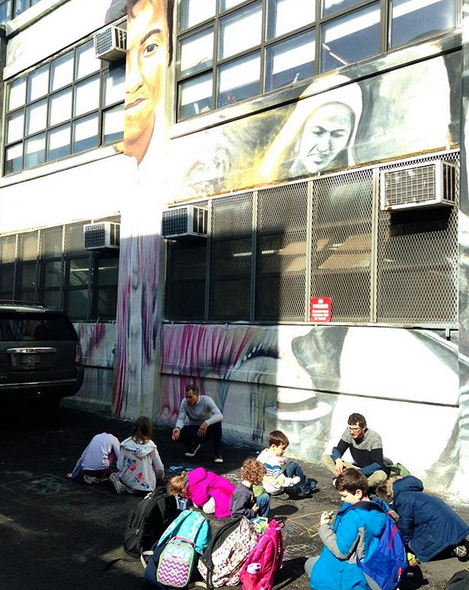
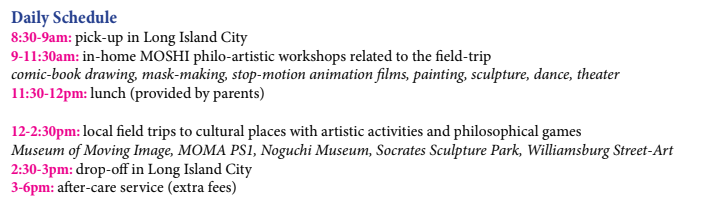
The activities were conducted indoor and outdoor. Families offered their home or the playroom in their condominium. From Monday to Friday, 9am to 3pm, children could play, debate, discover their neighborhood, visit local museums and make artworks based on a daily philosophical question: What is nature? What is respect? What is identity? What is art? What is community?
In the New York City camp, Friedrich Nietzsche’s mustache 🥸 was also used as a face make-up to symbolically empower children. However, we started the camp with Ralph Waldo Emerson’s philosophical ideas in order to help them transcend their pragmatic thinking into artworks:
“Do not go where the path may lead, go instead where there is no path and leave a trail.” Ralph Waldo Emerson
Children started the camp by role playing the Fable the Mountain and the Squirrel. They were asked to analyze the story problematized with Socratic questioning led by Moshi educator. In a world where it seems difficult for adults to find their place, we wanted to tackle the individuation problem as early as possible.
Following Carl Jung’s hero journey, we brought participants to discover their neighborhood in creative manners. The objective was for them to inquire into their surrounding world to start building their true self. At MoMA PS1 and Noguchi Museum, children could directly interact with abstract thinking through modern and contemporary artworks. They were asked to mimic abstract work of art. It allowed them to directly feel through their body what they were seeing. Therefore it helped them for philosophical reasoning and self-discovery.
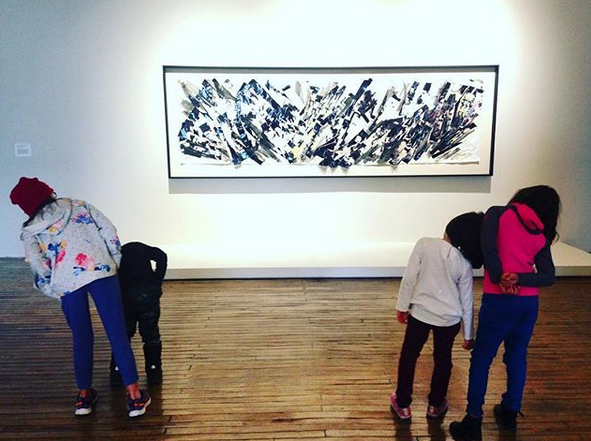
“Artists keep the world together by making amazing things that express people’s feelings. Artworks show the world how you feel about what’s happening” A., 9 years old
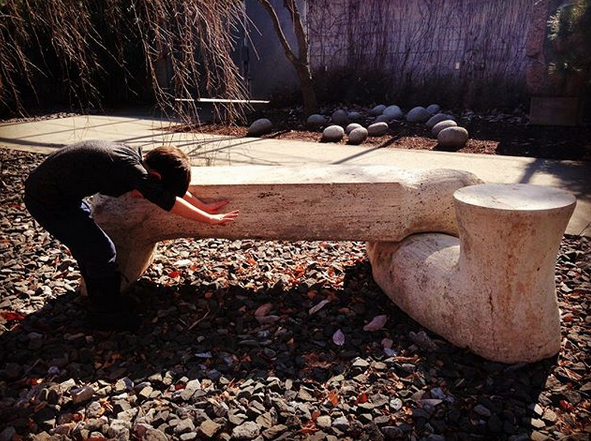
“Art gives sense to what seems nonsense” S., 9 years old
The essay was originally published in the collective book “Growing Up With Philosophy Camps. How Learning to Think Develops Friendship, Community, and a Sense of Self” (ed. Claire Katz), Rowman & Littlefield, 2020.